AI Visibility Score: Why Your Local Business Is Invisible to ChatGPT and Gemini
Learn what AI Visibility Score means for local businesses, why 30% of searches now bypass Google, and how to rank on ChatGPT and Gemini.
RankuTracker Team
July 6, 2026
The Search Landscape Just Changed — Again
If you run a dental clinic, law firm, or restaurant, you already know that ranking on Google Maps matters more than ranking on page one of traditional search. But there is a new shift happening right now that most local SEO tools are not measuring at all.
Approximately 30% of informational searches now happen through large language models: ChatGPT, Google Gemini, Perplexity AI, and Microsoft Copilot. People are typing questions like "What is the best family dentist near downtown Austin?" directly into ChatGPT and acting on the answer. They are asking Gemini for "a good Italian restaurant within walking distance of my hotel" and making reservations based on what the AI says.
Here is the problem: your Google Maps ranking means nothing if an LLM recommends your competitor instead of you.
This is why AI Visibility Score has become one of the most important metrics for local businesses in 2026, and why RankuTracker built Copilot AI to help you measure and improve it.
What Is AI Visibility Score?
AI Visibility Score (AVS) is a composite metric that measures how likely a local business is to appear in responses generated by large language models when a user asks a locally-relevant question.
Unlike traditional SEO metrics, which track positions in a ranked list of blue links, AI Visibility Score tracks something more complex: the probability that an AI model will mention your business, recommend your services, or include your name in a generated answer.
A business with a high AVS shows up when someone asks ChatGPT "who are the best immigration lawyers in Miami?" or when Gemini answers "which gyms near me have a sauna?" A business with a low AVS is simply invisible to those queries — even if it ranks #1 on Google Maps.
AVS is composed of four main signals:
- Entity recognition — Does your business exist as a clearly defined entity in publicly crawlable data?
- Structured data quality — Is your NAP (name, address, phone), schema markup, and GBP data consistent and complete?
- Content authority — Does your website publish content that answers the questions LLMs use to train their responses?
- Citation breadth — How many authoritative sources (directories, review platforms, local news, industry sites) mention your business?
Why Traditional SEO Tools Don't Measure This
Traditional SEO tools were built for a world where the search engine returns a ranked list and users click links. Their core products — keyword rank tracking, backlink analysis, domain authority — are designed to optimize for that click-based model.
LLMs don't return ranked lists. They synthesize information from their training data and, increasingly, from real-time retrieval. There is no "position 1" in a ChatGPT answer. There is either mentioned or not mentioned.
This means that:
- A keyword rank of #1 on Google does not guarantee AI visibility
- A business with few backlinks but excellent structured data and consistent citations can outrank a domain-authority-heavy competitor in LLM responses
- Technical SEO factors that matter for Googlebot (crawl budget, internal linking) are largely irrelevant to how an LLM encodes business information
Measuring whether ChatGPT or Gemini knows your business exists is simply outside the scope of what traditional, click-based SEO tools were built to do.
RankuTracker built Copilot AI specifically to fill this gap for local businesses.
How RankuTracker Measures AI Visibility Score with Copilot AI
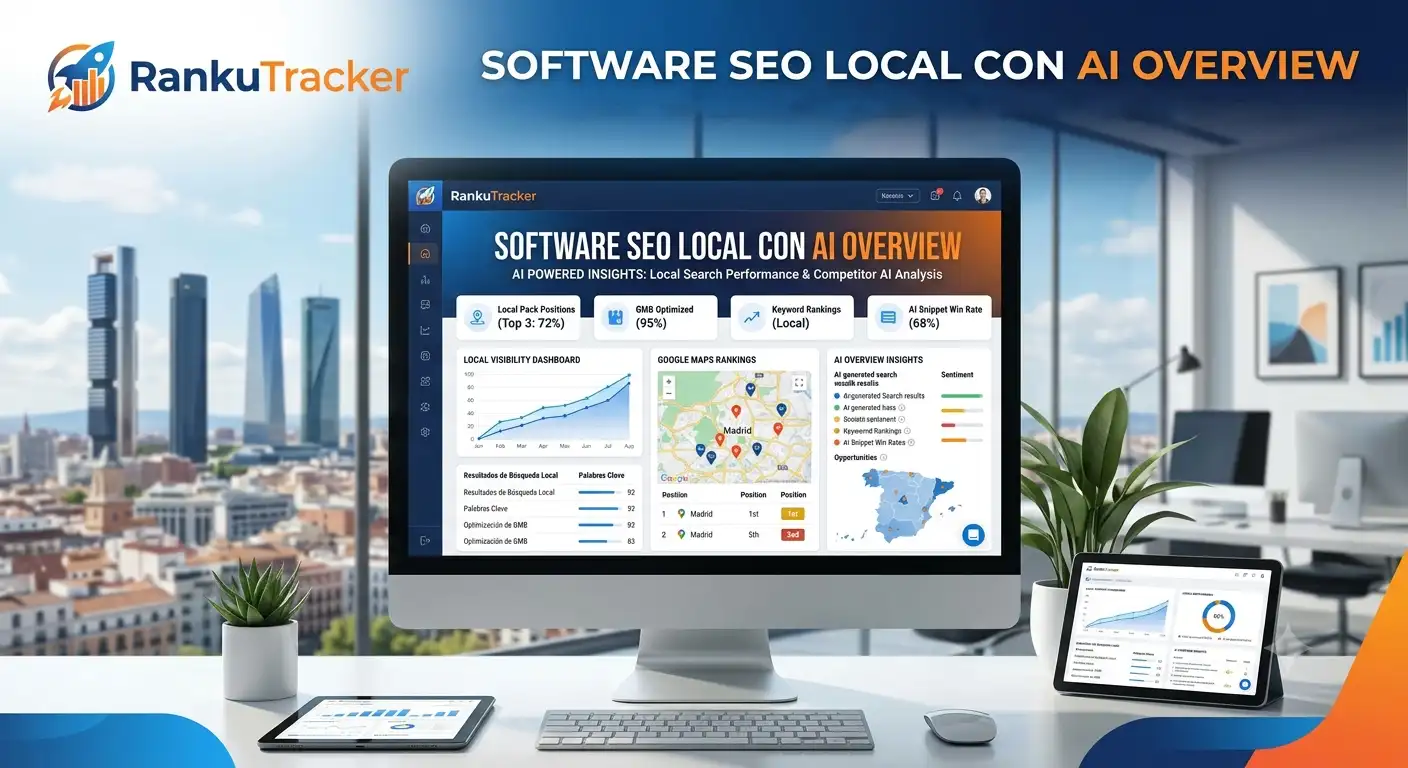
Copilot AI is RankuTracker's integrated SEO assistant. It connects your business data across all platform tools — RankTracker, RankMap, ScanSite, NAP Audit, and the AI Review Management module — to compute a unified AI Visibility Score for your location.
Here is what Copilot AI analyzes:
1. NAP Consistency Across the Web
Copilot AI pulls data from the NAP Audit module to assess how consistently your business name, address, and phone number appear across Google Business Profile, Yelp, Facebook, Apple Maps, Bing Places, and dozens of industry-specific directories.
LLMs ingest data from all of these sources. If your business name appears as "City Dental Center," "City Dental Center LLC," and "City Dental Ctr" across different platforms, the model may treat these as different entities or assign lower confidence to your business information.
NAP consistency score directly impacts your AVS.
2. Structured Data and Schema Coverage
ScanSite audits your website's technical SEO, including structured data markup. For AI visibility purposes, Copilot AI specifically checks for LocalBusiness schema, Review schema, FAQPage schema, and BreadcrumbList markup.
LLMs that use retrieval-augmented generation (RAG) — like Google's AI Overviews and Bing Copilot — parse structured data when generating answers. A local business with rich schema markup is significantly more likely to be cited in AI-generated responses.
3. Content Gap Analysis
Copilot AI analyzes the questions your target customers are asking LLMs and compares them to the content on your website. If people are asking ChatGPT "does this dental clinic accept Medicaid?" and you have no page or FAQ that answers that question, your AVS suffers.
The content gap report shows you exactly which questions you need to answer on your site to improve AI visibility.
4. Review Volume and Sentiment
Reviews are a primary training signal for local business information in LLMs. The AI Review Management module tracks your review volume, average rating, and response rate across Google, Yelp, and other platforms.
Businesses with more reviews, higher ratings, and active response patterns score higher for prominence — which is a key AI visibility factor.
The Difference Between Traditional SEO and GEO
Traditional SEO (Search Engine Optimization) optimizes your website and GBP to rank in Google's algorithmic search results. It focuses on keywords, backlinks, technical health, and on-page content. The success metric is position in a ranked list.
GEO (Generative Engine Optimization) optimizes your business's digital presence to appear in AI-generated answers. It focuses on entity clarity, citation consistency, structured data, FAQ content, and review authority. The success metric is mention rate in LLM responses.
The two disciplines overlap significantly but are not identical. Here is a practical comparison:
| Factor | Traditional SEO | GEO |
|---|---|---|
| Primary target | Googlebot | LLM training data + RAG |
| Key metric | Keyword ranking | AI mention rate |
| Content format | Long-form, keyword-dense | Q&A, structured, entity-clear |
| Link building | High priority | Secondary to citations |
| Technical focus | Crawlability, page speed | Schema markup, structured data |
| Tools | Traditional SEO platforms | RankuTracker Copilot AI |
A business that has done excellent traditional SEO already has a head start on GEO, but there are specific additional steps required.
5 Concrete Steps to Improve Your AI Visibility Score
Step 1: Audit and Unify Your NAP Data
Use RankuTracker's NAP Audit module to pull a full report of every mention of your business across the web. Identify discrepancies in your name, address, phone, website URL, and business hours. Fix inconsistencies starting with the highest-authority platforms (Google, Apple Maps, Yelp, Facebook).
Target: 95%+ NAP consistency score before moving to content work.
Step 2: Implement Full LocalBusiness Schema
Go to your website and implement comprehensive LocalBusiness JSON-LD schema. Include your business name, address, phone, hours, geo coordinates, price range, accepted payment methods, and services offered. Use ScanSite to verify the schema is valid and indexable.
If you have multiple locations, implement a separate schema block for each location page.
Step 3: Build an FAQ Content Layer
Research the questions your target customers actually ask LLMs about your type of business. Good starting points: Google's "People Also Ask" boxes, Reddit threads in your niche, and Perplexity AI searches for your category.
Create FAQ pages or expand existing service pages to directly and clearly answer these questions. Write in conversational language — the same way a patient would ask a question to a friend, not the way a marketer would write a keyword-stuffed paragraph.
Step 4: Increase Your Review Velocity
Google's AI Overviews and other AI systems use review signals as a quality indicator. Set up automated review request sequences using RankuTracker's AI Review Management module. After each appointment, transaction, or service delivery, trigger a review request via email or SMS.
Aim for at least two to four new reviews per month for a single-location business. Use the AI response templates to reply to every review — Google's systems reward engagement.
Step 5: Monitor Your AVS Monthly
Copilot AI generates a monthly AI Visibility Score report that tracks your progress across all four component signals: NAP consistency, structured data, content coverage, and review authority. Use this report to prioritize your work each month.
The businesses that win in AI search are the ones that treat it as an ongoing process, not a one-time setup.
Why This Matters More Than Anything Else in 2026
The numbers are stark. In 2023, nearly 100% of web searches that led to local business visits came through traditional search engines. By the end of 2025, research from multiple analytics firms showed that 28% to 32% of informational queries that previously went to Google were being captured by ChatGPT, Gemini, and Perplexity.
For local businesses, this matters because intent is high in LLM searches. Someone asking ChatGPT "what is the best personal injury lawyer in Denver?" is not browsing — they are about to make a call. If your business is not in the answer, you have lost that lead entirely.
This trend will accelerate. Google's own AI Overviews now appear at the top of results for a growing percentage of local queries. Microsoft Copilot is integrated into Windows 11. Apple Intelligence is rolling out across iOS. The search experience is becoming AI-mediated at every level.
Local businesses that invest in AI Visibility Score optimization now will be building a durable competitive advantage. Those that wait will find themselves invisible to an increasingly large share of their potential customers.
Getting Started with RankuTracker's AI Tools
RankuTracker was designed from the ground up for local businesses — dental clinics, law firms, restaurants, gyms, and other SMEs that compete at the neighborhood level. At $27/month, it includes AI Visibility Score measurement as a core part of the platform, not a bolt-on afterthought.
The Copilot AI module is included in all plans. When you connect your Google Business Profile and run your first audit, you receive an immediate AI Visibility Score with a prioritized action list. Most businesses see measurable score improvements within 60 days of implementing the recommended changes.
Conclusion
The local search landscape has split into two channels: traditional Google ranking and AI-generated responses. Winning in 2026 means being visible in both. Traditional SEO tools measure the first channel but are blind to the second.
AI Visibility Score is the metric that fills this gap. RankuTracker's Copilot AI, backed by our AI Overview Tracker, gives local businesses the ability to measure, track, and improve their presence in LLM-generated answers — a capability that simply does not exist in any competing tool at this price point.
The businesses that show up when someone asks ChatGPT for a recommendation are the businesses that will grow. Make sure yours is one of them.
Try RankuTracker free for 14 days at rankutracker.com and check your own AI Visibility Score with AI Overview Tracker.