From SEO Audit to Freelance Action: An Integrated Ecosystem for Local Success in 2026
Discover how to turn local SEO audits into an actionable growth engine through hyperlocal precision, artificial intelligence, and an integrated marketplace of specialized freelancers.
Ranku Team
January 15, 2026
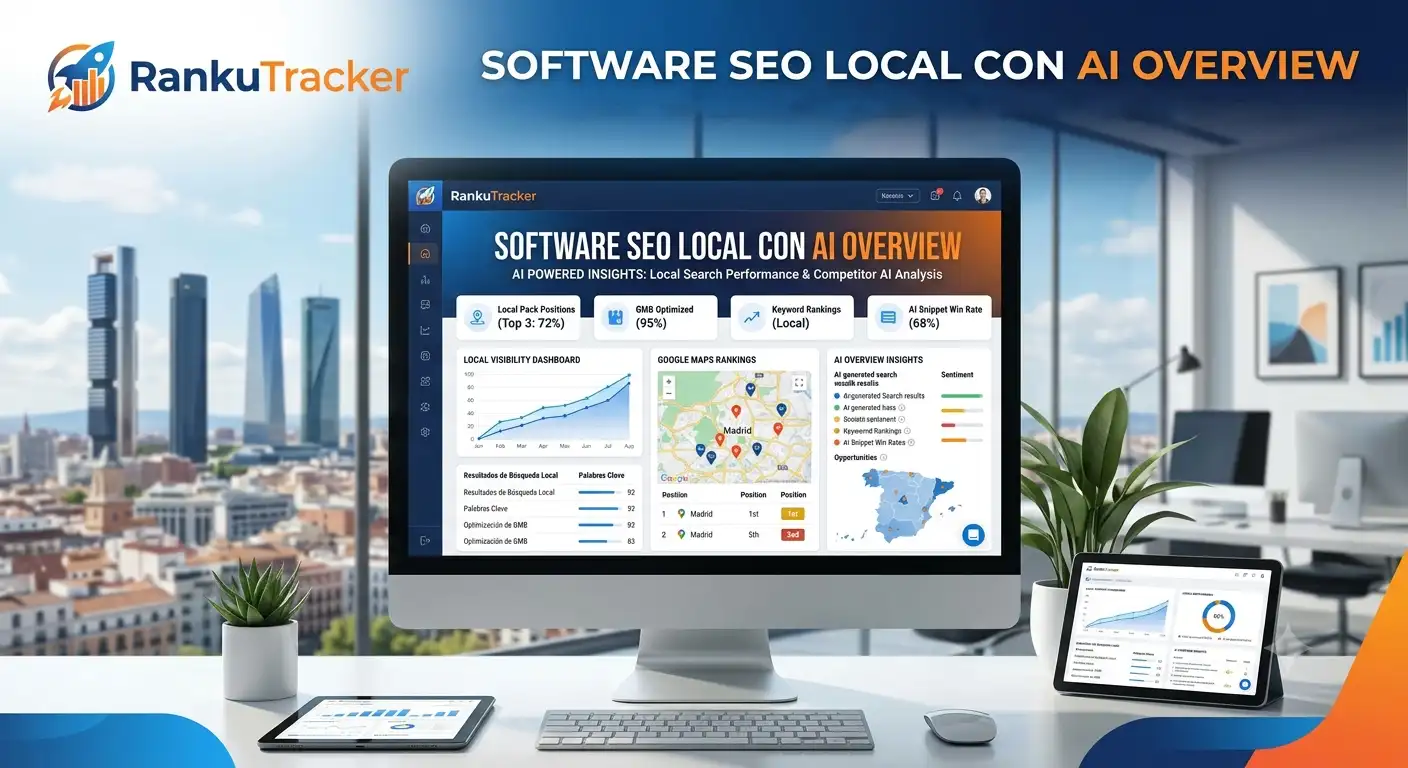
In 2026, local SEO is no longer a secondary tactic—it’s the primary growth lever for brick-and-mortar businesses, freelancers, and brands that thrive on their immediate surroundings. Winning on Google is no longer achieved through shortcuts or copied strategies; it demands hyperlocal precision, deep algorithmic understanding, and—above all—the ability to act instantly. This is where Ranku, with RankTracker, ScanSite, RankMap, Review Management, LLMs.txt Generation, and access to specialized freelancers, redefines the game: it doesn’t just diagnose with unprecedented accuracy—it eliminates the gap between insight and solution. By integrating cutting-edge SEO technology and freelance talent into a single platform, every insight becomes a real, rapid, and cost-efficient action.
In this article, we explore why this combination isn’t just another tool—but an integrated ecosystem designed to transform local visibility into measurable revenue, both for businesses and freelance professionals.
Foundations of the Modern Audit: Hyperlocal Segmentation with RankMap and Strategic Reasoning Conducting a comprehensive SEO audit in 2026 has evolved beyond mere diagnosis into a strategic process essential for the survival and growth of any business with a physical presence or localized service. The digital landscape no longer tolerates generic templates or optimization based on outdated intuition; competition demands precise, multifaceted, and actionable insights into online visibility. In this context, Ranku’s auditing methodology represents a paradigm shift—moving focus from traditional geographic segmentation (cities, districts) to surgical precision based on exact geographic coordinates. This approach, powered by RankMap, isn’t an incremental improvement but a redefinition of how local markets are understood and acted upon. The core premise is that real-world proximity—measured in meters, not kilometers—is one of Google’s most critical and dynamic ranking factors for personalizing search results. Two adjacent streets can display radically different rankings for the same query, a phenomenon only captured by simulating searches from specific, business-relevant geographic points.
The first step in a modern SEO audit is therefore detailed geographic segmentation and initial setup. Technically, this involves using RankMap, a feature that transforms the interactive map into a live positioning lab. Unlike other tools that offer heatmaps or statistical estimates, RankMap allows users to place markers at precise locations—such as a building entrance, a bus stop, or a specific neighborhood spot—and run search simulations from those points. Each map point represents a potential real customer search, delivering an operational—not theoretical—view of business visibility. This segmentation capability reveals consumer behavior patterns invisible to broader methods. For example, a professional firm might discover its visibility is excellent within a 1-kilometer radius but drops sharply just beyond a major avenue that acts as a psychological or physical threshold for target clients. For a restaurant franchise, this could mean the difference between dominating a shopping center and being invisible to competitors across the street.
From a practical standpoint, this hyperlocal segmentation translates into tangible business decisions. Take a dental clinic in a densely populated city. Using RankMap, the SEO specialist can identify all residential buildings within a 500-meter radius and simulate searches from each for terms like “dentist near me” or “dental implants [street name].” Results may show the dentist ranks #1 in the northern part of the neighborhood but falls to page two in the south—despite similar proximity. Analyzing that specific zone reveals direct competitors have heavily optimized their Google Business Profile (GBP) and accumulated numerous positive reviews containing keywords like “family-friendly care” and “easy booking,” which resonated strongly in that area. This objective—not intuitive—insight enables the dentist to craft a targeted content and review strategy specifically for that underperforming zone, perhaps launching a review campaign around those same values or creating website content that explicitly addresses those local needs.
The strategic reasoning behind this hyperlocal precision is twofold. First, it responds to Google’s evolving algorithms, which increasingly weigh real-time user proximity. Ignoring this reality means SEO efforts are based on an idealized model that doesn’t reflect actual customer experience. Second, it enables far more efficient resource allocation. Instead of trying to improve general city-wide rankings indiscriminately, budget and time can be focused on zones with the highest opportunity to gain market share or where visibility loss has the most direct economic impact. By offering this actionable view, uncertainty is eliminated, and geography becomes a strategic asset that can be managed and optimized. The ability to visualize competitors at every map point—comparing who ranks where and why—provides immense competitive advantage. For instance, a signmaker in Saint Augustine, FL, could use RankMap to identify vacant commercial properties in high-traffic areas and check whether competitors have strong visibility there, helping decide where to invest in new signage for maximum exposure. This capacity to move instantly from analysis to action is what defines this approach as an integrated ecosystem—not just a diagnostic tool.
Below is a table summarizing the conceptual differences between traditional audience analysis and Ranku’s hyperlocal segmentation with RankMap:
This foundation of hyperlocal segmentation is the indispensable starting point for any modern audit. Without precise understanding of where and how a business is visible to potential customers at the exact moment of their search, all subsequent steps lack a reliable frame of reference. Through RankMap, this framework is established with unprecedented precision, enabling every follow-up analysis—whether desktop, mobile, or Google Business Profile—to be conducted with acute awareness of the spatial dimension governing local SEO in 2026. This approach is not only technical but deeply strategic, transforming geospatial data into actionable business intelligence and closing the gap between search engine optimization and tangible business outcomes.
Deep Desktop Environment Analysis: Authority, Content, and Credibility Building Once the hyperlocal geographic foundation is established, the next critical pillar of a comprehensive SEO audit is an exhaustive analysis of the desktop environment. While current local SEO narratives often emphasize mobile searches and Google’s Map Pack, ignoring the desktop universe amounts to building an incomplete and vulnerable strategy. Desktop remains a crucial engine for building authority, capturing long-cycle leads, and validating business credibility among audiences conducting deeper research. Recognizing this duality, Ranku isolates and analyzes desktop performance separately, delivering insights that are distinct—and often complementary—to those gathered from mobile devices. This separation is essential because ranking factors differ significantly: on desktop, domain authority, content depth and quality, robust technical structure, and relevant inbound links dominate, whereas mobile prioritizes speed, user experience, and immediate intent.
Technically, the desktop audit focuses on classic SEO metrics—but contextualized within local logic. It begins with evaluating Domain Authority (DA) and Page Authority (PA), comparing these indicators not only against general competitors but specifically against key local competitors for target queries. Ranku facilitates this comparison with clear charts and tables highlighting strengths and weaknesses. A specialized freelancer can quickly identify if a local competitor holds an overwhelming authority advantage due to a solid history of inbound links from relevant local domains—such as digital newspapers, business associations, or community news blogs. This reveals a strategic gap: the goal isn’t necessarily to outpace the competitor in raw DA, but to build more relevant, localized authority.
The second technical component is semantic and structural content analysis. Ranku scans the website to assess whether service and category pages are optimized with appropriate density and distribution of local keywords. For example, for a law firm, this would involve verifying that pages like “labor lawyer Bilbao” or “immigration law firm in Portugalete” contain not only the primary keyword but also synonyms and related queries (“Vizcaya courts,” “Spanish citizenship process”). Beyond simple keyword density, it evaluates semantic content quality, looking for structured data (Schema.org) that helps Google better understand the business, its services, and geographic scope. A common error is a misconfigured LocalBusiness Schema or omitting the areaServed field, confusing search engines about the service’s geographic reach.
Practically, these techniques translate into concrete actions. Consider a law firm aiming to improve visibility for “family lawyer in Barakaldo.” The audit reveals decent organic rankings but lower DA than two key competitors. Backlink analysis shows those competitors have multiple links from a local legal publication and a regional business magazine. The strategic action derived isn’t to buy low-quality links, but to launch an ethical, community-oriented link-building campaign. The freelancer might contact the publication to propose a guest op-ed by a firm partner on a local legal trend, or collaborate with the magazine to create valuable content. This not only generates high-authority, relevant backlinks but also cements the firm’s reputation as a community leader—a factor Google highly values in local SEO.
Another practical aspect of desktop analysis is reviewing the site’s internal structure. Ranku can generate sitemaps and link diagrams to identify scalability issues and authority hierarchy problems. A common issue on large sites is authority fragmentation, where low-traffic service pages don’t receive enough “authority equity” from the homepage or blog. The audit might recommend creating logical navigation paths and implementing strategic internal linking—where authority-rich pages (like a legal blog) naturally link to relevant service pages. This ensures authority built through blog content is shared and benefits conversion pages.
The strategic reasoning behind desktop analysis is multifaceted. First, while immediate local searches (“restaurant open now”) are predominantly mobile, many high-value decisions begin with desktop research. A client seeking an “immigration law firm” or a “physiotherapy clinic” for long-term treatment will likely start on a computer to read reviews, compare lawyer profiles, or understand procedures. Strong desktop positioning during this consideration phase is crucial to guide users toward conversion. Second, domain authority is a global ranking factor that indirectly influences local SEO. A strong, Google-respected domain is more likely to appear in local search results—even for users not explicitly searching within their immediate geographic area. Third, desktop content often serves as the business’s “sales engine.” Blog posts, case studies, detailed guides, and full testimonials—which thrive on desktop interfaces—provide the context needed for users to trust a business before visiting the services page or calling.
In summary, desktop environment analysis isn’t a formality—it’s an integral part of a holistic local SEO strategy. By enabling isolated, deep analysis of this environment, Ranku equips specialists with the insights needed to strengthen a business’s authority foundation, enhance credibility, and capture qualified leads early in the conversion funnel. Ignoring this universe leaves a third of the battlefield unprotected, compromising the brand’s resilience and long-term growth potential.
Critical Mobile Environment Optimization: Speed, UX, and Instant Conversion If the desktop environment focuses on authority and depth, the mobile environment is where the battle for attention and instant conversion is won. In local SEO—where user intent is often immediate (“I want to eat here,” “I need a mechanic now”)—the mobile experience isn’t a secondary detail; it’s the core of visibility strategy. A comprehensive SEO audit dedicates a critical section to this environment, recognizing that a website flawless on desktop can be entirely unusable on a phone. Mobile optimization goes beyond basic compatibility; it encompasses technical and design factors centered on load speed, usability (UX), and eliminating all friction on the path to the desired action. Ranku measures and analyzes these factors specifically for mobile, providing a precise roadmap to improve performance—and consequently, ranking and conversion.
Technically, the mobile audit focuses on metrics officially recognized by Google as ranking factors. Most prominent is load speed, evaluated through Core Web Vitals indicators: LCP (Largest Contentful Paint), FID (First Input Delay), and CLS (Cumulative Layout Shift). Ranku simulates page loading from various locations and network conditions (e.g., 4G/5G) to deliver a realistic performance picture. A freelancer can identify issues like unoptimized images, render-blocking JavaScript, or slow servers that negatively impact user experience. For example, a restaurant audit might reveal its main menu—the largest image on the page—takes over 5 seconds to load on a standard mobile connection. This severe LCP failure penalizes rankings and frustrates users, who often abandon the page before it fully loads.
Beyond speed, analysis extends to user experience (UX) and usability. Ranku enables visual and functional mobile site audits, focusing on critical details: Is the “Reserve Table” button easy to tap? Is the contact form visible and simple enough to complete with one thumb? Are navigation menus accessible without constant zooming? These seemingly trivial details directly impact bounce rates and the site’s ability to convert visitors into customers. A practical case: a small bakery with delivery finds its mobile site well-designed, but the shopping cart is overly complex—requiring too many clicks to add items and proceed to checkout. Additionally, the “Call Now” button isn’t a native phone link but an image, forcing users to manually copy and paste the number. These minor deficiencies, detected by a specialized auditor, represent unnecessary barriers leading to direct sales loss.
The strategic reasoning behind mobile optimization is direct and pragmatic. Mobile user intent is almost always transactional or immediate-information-seeking. A user searching “nearest emergency pharmacy” has no time to wait for a slow-loading page or wrestle with a complicated form. Friction is mobile conversion’s #1 enemy. Optimizing for mobile is essentially maximizing user-path efficiency toward action. Moreover, Google uses mobile interaction metrics to infer user experience quality. A site with high mobile bounce rates and low session duration is flagged by the algorithm as unsatisfactory—resulting in ranking penalties, regardless of desktop performance. Ranku closes this feedback loop by providing concrete data to justify optimization investments. For instance, if the audit shows the restaurant loses 40% of users on the first screen due to poor menu experience, the owner understands why improving that element isn’t an expense—but an investment in recovering lost revenue.
Practical applications of this audit are vast and adaptable to any local business. For a professional service like architecture, mobile optimization might involve ensuring project portfolios are easily navigable vertically, CVs and certifications are available in quick-read formats, and contact forms are minimal. For a chimney cleaning service, the priority would be a highly visible “Get Free Quote” button and a mobile-friendly online booking calendar. The audit provides a template for these optimizations, allowing freelancers to identify urgent issues and prioritize development tasks.
Finally, mobile optimization isn’t a one-time project—it’s an ongoing process. Technologies evolve, user habits shift, and competitors continuously improve their own experiences. Ranku enables continuous tracking of mobile metrics, alerting to regressions (e.g., sudden load-time spikes after a CMS update) and measuring the impact of implemented improvements. This “audit → optimize → measure” cycle is essential for maintaining sustainable competitive advantage in the dynamic mobile local SEO landscape. The ability to isolate and analyze this environment separately is therefore indispensable for any business aiming to be found and chosen by customers seeking solutions instantly on their preferred device.
Mastering the Google Business Profile Environment: Reputation, Proximity, and Recent Activity The Google Business Profile (GBP) environment is the epicenter of local SEO in 2026. Here—in Google’s famous “Map Pack”—user proximity, commercial intent, and business reputation converge at a single interaction point. A comprehensive SEO audit assigns paramount importance to this environment, treating it not as a checklist but as a dynamic ecosystem requiring constant monitoring, strategic optimization, and proactive management. Ranku isolates the GBP universe and analyzes it independently, giving SEO specialists a clear view of how their client—and competitors—are perceived by Google and, ultimately, potential customers. Mastering this environment is synonymous with mastering local SEO.
From a technical standpoint, the GBP audit focuses on three fundamental pillars. The first is profile optimization itself. This includes a thorough review of every field: name, category, address, phone, and website. Ranku verifies NAP (Name, Address, Phone) consistency between the GBP and the rest of the website and online directories—a critical ranking factor Google uses to validate business legitimacy and location. The audit also evaluates whether primary and secondary categories best capture all customer search variants (e.g., a florist should also be tagged with “deliveries” and “gifts”).
The second technical pillar is review management. Reviews are now among the most influential local SEO factors, affecting not only rankings but also trust perception, CTR, and Google’s semantic interpretation of the business. Ranku transforms review analysis from a manual, subjective task into a quantitative and qualitative process. Technically, the tool extracts all recent and historical reviews, classifying them and analyzing text to detect local-intent keywords and sentiment (positive, negative, neutral). For example, for a boutique hotel, analysis might reveal that frequent mentions of “included breakfast” and “attentive staff” in positive reviews correlate with higher rankings. This provides empirical evidence of which service aspects customers value most—and should be highlighted.
The third technical pillar is recent activity. Google favors business profiles that demonstrate active community engagement. Ranku monitors GBP activity—including posts, photo/video uploads, and review responses. The audit evaluates the frequency and quality of this activity, recommending a publishing calendar to keep the profile fresh and algorithm-relevant. For example, a gym audit might suggest regularly posting announcements about new classes, sharing health tips, or showcasing club event photos.
From a practical perspective, these audit techniques translate into concrete actions with direct visibility and reputation impact. Take an aesthetics clinic. The audit reveals that despite a good overall rating, a concerning pattern exists: several recent 1-star reviews originate from the same IP and lack photos—suggesting possible sabotage by a competitor. The correct action, based on this detection, is to report these reviews to Google through proper channels for review. Additionally, analysis of positive reviews shows customers especially value “clean facilities” and “relaxing atmosphere.” Based on these findings, the clinic can respond to positive reviews by mentioning these points—reinforcing its message and helping Google understand its strengths.
Another practical scenario: a restaurant aiming to improve rankings for “Italian food in Madrid.” The audit shows its GBP lacks high-quality photos of signature dishes. The strategic recommendation is clear: invest in professional food photography and upload these images to the profile. High-quality visuals not only boost Map Pack CTR but also enhance restaurant perception. Additionally, the audit might detect that a relevant secondary category—like “Italian delivery”—isn’t enabled. Activating this category expands profile reach to users searching for food delivery, capturing a different search intent.
The strategic reasoning behind this intensive GBP audit is that it serves as the business’s digital “front door.” It’s often a potential customer’s first touchpoint. An optimized GBP—with solid reputation and consistent activity—acts as a powerful conversion agent, guiding users from search to action (call, directions, reservation). Ranku provides the roadmap to build and maintain this impeccable front door. By isolating this universe, the tool allows SEO specialists to directly measure the impact of GBP actions—like responding to reviews or posting content—on Map Pack rankings, creating a fast, effective feedback loop. In a saturated market where differentiation is key, a meticulously audited and optimized GBP can be the decisive competitive advantage.
The SEO Frontier: Semantic Analysis and Optimization for Generative AI (LLMs) As an SEO specialist, it’s imperative to look beyond traditional search results and anticipate the future frontiers of online business discovery. In 2026, search is undergoing profound transformation driven by the proliferation of Large Language Models (LLMs) like ChatGPT, Gemini, and other generative AI assistants. Increasingly, users aren’t typing queries into a search box—they’re asking conversational questions directly to voice or text assistants: “Who’s the best divorce lawyer in Barcelona based on my criteria?” or “Recommend a great restaurant with a terrace for an anniversary.” This evolution redefines SEO: it’s no longer just about appearing on Google’s first page, but about being “discovered” and “recommended” by AI itself. Recognizing this trend, Ranku incorporates a cutting-edge feature that audits and optimizes websites not only for Google’s algorithms but also for interpretability by language models—a capability that positions platform users ahead of the competitive curve.
Technically, generative AI auditing materializes through automatic generation of an LLMs.txt file. This file is an addition to the standard robots.txt protocol, but its purpose is radically different. While robots.txt tells search engine crawlers what not to index, LLMs.txt is a machine-readable “introduction letter” that clearly explains who the business is, what it does, where it operates, and what values define it. Ranku automates this file’s creation by analyzing website content, metadata, Schema, and other contextual data to synthesize concise, relevant information. For example, for a law firm, the file might state: “We are ‘González & Associates,’ a law firm specializing in labor and tax law in Madrid. We represent both companies and individuals. Our founding partner, Juan González, has over 15 years of experience in unfair dismissal litigation.”
This technical action has deep strategic impact. By providing structured, truthful information to LLMs, the business dramatically increases its chances of being selected as a reliable source for generating conversational responses. When a user asks their AI assistant a question, the model can consult the business’s LLMs.txt to obtain an accurate, up-to-date description—enabling it to construct a more informed, relevant response that includes the business as a recommended option. This expands visibility beyond the classic search engine, positioning the business in an emerging discovery channel. SEO is no longer just a race for top rankings—it’s also an effort to become AI’s preferred “source.”
Practical applications of this optimization are diverse and strategically powerful. Consider a digital marketing freelancer working with a new n8n automation center in Valencia. After an audit, they generate an LLMs.txt file describing the center, its specialists, training and consulting services, and coverage areas. Months later, an entrepreneur in Alicante asks their company chatbot: “Do you know any centers in Spain offering advanced n8n training with a B2B workflow automation focus?” The LLM consults thousands of business LLMs.txt files, finds the Valencia center’s precise description, and includes it in the response. This entrepreneur—who never performed a traditional search—becomes a qualified lead thanks to the business’s preparation for the AI era.
For an Instagram-specialized freelancer, this feature may seem less direct—but its impact is equally significant. An interior designer using Instagram as their main prospecting channel can use LLMs.txt to ensure that when someone asks an AI, “Where can I find inspiration for decorating a modern apartment in Ibiza?” the model can link to the designer’s profile and featured Instagram works (if properly linked on their website). This bridges visual content marketing and semantic search optimization, multiplying discovery opportunities.
The strategic reasoning behind this innovation is clear: technology waits for no one. LLMs are already here and beginning to influence enriched search results and generative responses. Businesses that fail to prepare to be “read” by AI risk exclusion from this new form of digital interaction. By integrating this auditing and optimization capability into everyday workflows, Ranku democratizes access to this competitive advantage—enabling even small local businesses to position themselves for the future. The ability to “also appear in AI” isn’t a luxury—it’s a strategic necessity to ensure long-term relevance and visibility in a constantly redefining digital ecosystem. By combining hyperlocal precision, multi-environment analysis, and AI readiness, Ranku delivers an SEO audit solution that not only meets today’s demands but also builds a solid foundation to dominate tomorrow’s discovery channels.
From Diagnosis to Action: Connecting Audited Problems with Freelance Solutions The true value of an SEO audit lies not solely in diagnostic quality, but in its ability to transform knowledge into concrete actions that generate measurable business results. This is where Ranku fundamentally differs from other market tools: it doesn’t stop at analysis—it integrates a complete execution ecosystem through its marketplace of specialized freelancers. This approach solves local SEO’s main bottleneck: the disconnect between those who perform audits and those who implement improvements. By directly connecting audit-identified problems with capable freelancers within a single secure platform, Ranku dramatically accelerates the “analyze → act → measure” cycle—eliminating friction, delays, and extra costs.
The process is intuitive and efficient. After completing a detailed audit, the output is a data-rich report that not only highlights problems but often suggests solutions. For example, the audit might identify that the client’s website has very slow mobile load speed, negatively impacting rankings. Instead of searching externally for a developer, emailing proposals, evaluating budgets, and managing the project separately, the client can post a free project directly on the marketplace with a clear task description like “Optimize website for mobile and improve Core Web Vitals.” The selected freelancer is a WordPress and responsive theme specialist. Communication and payment are handled within the platform, ensuring transparency and security.
Below are five specific examples of how audited problems translate into projects executed by IT freelancers—covering a range of specialties critical to local digital success.
- The Web Development Specialist: Solving Fundamental Technical Issues Audited Problem: The audit reveals a café chain’s website loads slowly—especially on the main menu page—and isn’t fully compatible across all browsers. Additionally, HTML validation errors may affect accessibility and semantic SEO. Executed Solution: The client posts a project titled “Restructure and optimize website to improve speed and compatibility.” They hire a web development freelancer experienced in PHP, JavaScript, and CSS frameworks. The freelancer performs deep code analysis, optimizes menu images, implements lazy loading for non-critical scripts, fixes HTML errors, and ensures responsive design across all screen sizes. The result is a faster, more reliable, and accessible website—leading to significant Core Web Vitals improvements and, consequently, better Google rankings.
- The Google Ads Campaign Expert: Expanding Visibility Through Paid Advertising Audited Problem: SEO analysis shows good organic rankings, but direct click-through traffic remains insufficient. Keyword auditing indicates high commercial demand for terms like “traffic lawyer in Seville” that aren’t being effectively captured. Executed Solution: The client posts a project for “Managing and optimizing Google Ads campaigns for lead generation.” They hire a PPC (pay-per-click) and ROI expert with local campaign experience. This professional designs and manages highly targeted search campaigns, using ad extensions to display address and phone number, and creates remarketing lists to re-engage website visitors who didn’t convert. The freelancer also uses SEO audit insights to refine keyword selection and ad copy—ensuring full alignment between organic and paid strategies.
- The Instagram Specialist: Boosting Brand Through Visual Visibility Audited Problem: For fashion or restaurant businesses, traditional SEO audits don’t capture the importance of visual social presence. The business’s Instagram account has few followers and generates minimal engagement. Executed Solution: The client hires an Instagram Marketing specialist. This professional analyzes Instagram competitors, develops a brand-aligned visual content strategy, and creates a posting calendar. They implement post and story promotion campaigns, use strategic hashtags, and establish collaborations with local micro-influencers. Crucially, the freelancer ensures all bio links and call-to-actions in posts direct to the recently optimized website—creating a positive feedback loop between social visibility and website conversion.
- The Mobile Optimization (UX/UI) Specialist: Eliminating User Experience Friction Audited Problem: The mobile audit identifies specific UX issues: the contact form is long and confusing, navigation menus are hard to use on touchscreens, and the “Call Now” button isn’t a native phone link. Executed Solution: A project is opened for “Improving mobile site user experience and usability.” A UX/UI and front-end development freelancer is hired. This expert conducts real-user usability tests, simplifies the contact form to essential fields only, and designs mobile-optimized navigation. They also convert phone numbers into clickable call links and ensure all interactive elements are thumb-friendly. These seemingly small improvements reduce mobile bounce rates and increase the likelihood of desired user actions—boosting conversion metrics and, consequently, rankings.
- The Automation Specialist (n8n / Make): Saving Time and Improving Operational Efficiency Audited Problem: Managing reviews on Google, Yelp, and Trustpilot is manual, time-consuming, and often delayed. Inventory synchronization between the website and point-of-sale system is also a manual, error-prone process. Executed Solution: The client hires a workflow automation specialist experienced in n8n or Make. This professional designs and implements automated workflows. For example, one flow automatically detects new positive Trustpilot reviews, publishes them to the client’s Google Business Profile, and features them in a “Testimonials” section on the website blog. Another flow automates website inventory updates whenever a sale occurs at the point of sale. These automations free the client’s team to focus on higher-value activities while improving NAP consistency and online reputation—key factors for local SEO.
In conclusion, the true power of an audit lies not just in its technical depth or hyperlocal precision—but in its ability to catalyze action. By bridging the gap between analysis and execution through its verified professional marketplace, Ranku doesn’t sell a tool—it delivers accelerated, predictable results. It transforms the audit from a static document into the starting point of a dynamic project—where problems become tasks, and tasks translate into tangible growth for the local business.