Traditional SEO vs AI-Powered SEO: The Real Evolution of Search Visibility
SEO is no longer split between technical and content. In 2026, the real divide is between traditional SEO and AI-driven SEO. Discover how search visibility has changed—and what you need to stay relevant.
Ranku Team
December 1, 2025
SEO has changed more in the last three years than in the entire previous decade. For years, organic ranking relied on relatively stable rules: keywords, links, site architecture, and optimized content. That model—the traditional SEO approach—is still relevant, but it’s no longer enough.
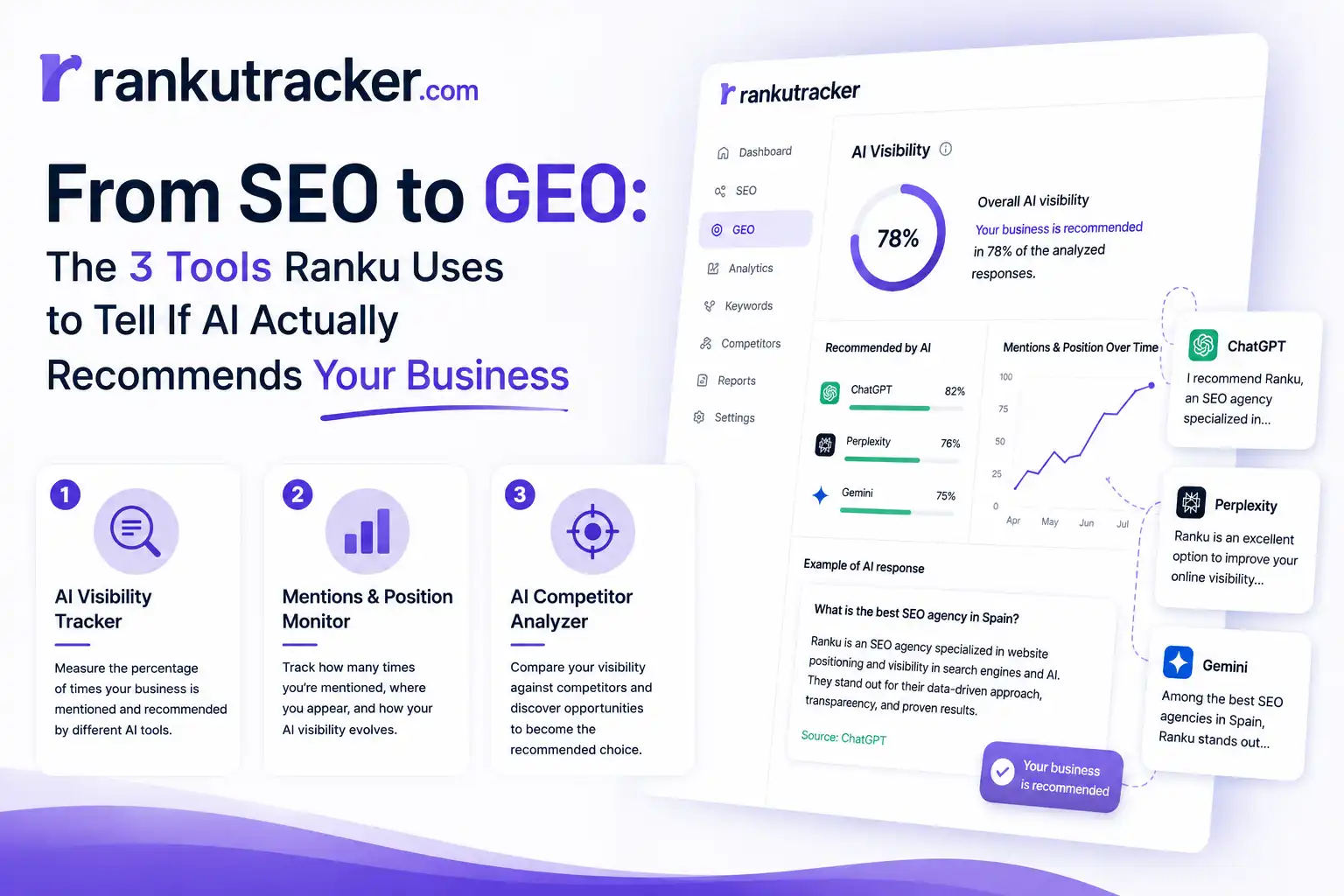
The rise of artificial intelligence has transformed how Google interprets queries, how users consume information, and—most importantly—how visibility is awarded to businesses. Today, we’re not just competing in rankings; we’re competing in AI-generated answers, conversational assistants, and contextual recommendation systems.
In this article, we cut through the noise and hype to analyze the real difference between traditional SEO and AI-powered SEO: what’s changed, what remains, and how to prepare for an ecosystem where search engines don’t just index—they reason.
What Is Traditional SEO?
Traditional SEO relies on a set of practices designed to optimize websites according to classic search engine criteria.
Its historical pillars have been:
- Keyword research
- On-page optimization (titles, H1s, content)
- Technical SEO (speed, indexing, architecture)
- Link building
- Domain authority
- Basic user experience
This approach assumes a clear premise:
👉 If you meet known ranking factors, you’ll improve your position.
For years, this worked because algorithms were deterministic: they evaluated concrete signals using relatively predictable rules.
The Problem with Traditional SEO in 2026
Today, traditional SEO faces three major limitations:
- It doesn’t understand complex intent
It optimizes words, not contexts. - It’s reactive, not predictive
It analyzes what happened, not what’s coming. - It doesn’t “talk” to AI
It’s built for crawlers—not language models.
This doesn’t mean traditional SEO is dead. It means it no longer competes alone.
The Rise of AI-Powered SEO
AI-powered SEO doesn’t replace traditional SEO—it expands and reconfigures it.
Here, the goal isn’t just to rank a URL, but to ensure a business is understandable, relevant, and selectable by intelligent systems.
AI operates across three critical layers:
- Query interpretation
- Entity evaluation (businesses, brands, experts)
- Response and recommendation generation
When a user asks:
“Which dental clinic is best near me?”
AI doesn’t just look for keyword matches. It evaluates:
- Reputation
- Specialization
- Geographic context
- Semantic consistency
- External signals
This is where traditional SEO starts to fall short.
Direct Comparison: Traditional SEO vs AI-Powered SEO
Approach
Traditional SEO
Optimizes web pages.
AI-Powered SEO
Optimizes entities, context, and meaning.
Keywords
Traditional SEO
Exact or semantically related keywords.
AI-Powered SEO
Intentions, questions, scenarios, and natural language.
Content
Traditional SEO
Content optimized for rankings.
AI-Powered SEO
Content designed to be understood, cited, and recommended by language models.
Measurement
Traditional SEO
Rankings, traffic, CTR.
AI-Powered SEO
Presence in generative answers, semantic authority, and indirect visibility.
Competitive Advantage
Traditional SEO
Correct technical execution.
AI-Powered SEO
Deep business understanding + AI-ready structure.
The Key Shift: From URLs to Entities
The biggest conceptual leap in AI-powered SEO is this:
Google and language models no longer rank just pages—they rank entities.
An entity can be:
- A business
- A professional
- A brand
- A localized service
Your website is only one source feeding that entity.
That’s why you can have a technically perfect site and still not appear in AI responses. The system simply doesn’t “recognize” you as a clear reference.
AI’s Role in Modern SEO
Artificial intelligence now actively shapes:
- Result ranking
- Spam detection
- Semantic interpretation
- Snippet generation
- Conversational search
- Local recommendations
This forces businesses to structure themselves for AI comprehension, not just crawler compatibility.
Two elements are now critical:
- Specialized AI assistants
- Explicit business structuring for language models
Copilot AI: From Analysis to Real Strategy
A common mistake is using generic AI for SEO tasks.
Effective AI-powered SEO requires models trained on real-world SEO data—not generic prompts.
Ranku’s Copilot AI is built specifically for this reality:
- Analyzes full SEO projects
- Understands local, technical, and semantic context
- Prioritizes actions by real-world impact
- Translates data into executable decisions
It doesn’t replace professionals—it amplifies them.
It shifts you from “what’s wrong?” to “what should I do first, and why?”

LLMs.txt: The New Strategic File in AI-Powered SEO
One of the most overlooked—and decisive—elements of AI SEO is the LLMs.txt file.
While:
robots.txttalks to crawlerssitemap.xmlorganizes URLs
LLMs.txt speaks directly to language models.
What Does LLMs.txt Do?
It defines, in structured format:
- Who you are
- What services you offer
- Where you operate
- What makes you different
- How AI should interpret you
In practice, it’s a semantic identity layer.
Why Is It Critical?
Because AI assistants:
- Don’t crawl the web like Google
- Need explicit context
- Select clear, coherent entities
Without LLMs.txt, you rely on indirect interpretation.
With LLMs.txt, you actively shape how AI understands you.
Ranku enables automatic, coherent generation of this file—aligned with your actual SEO strategy.

Is Traditional SEO Still Necessary?
Yes—but it’s no longer sufficient on its own.
Modern SEO works in layers:
- Solid technical foundation (traditional SEO)
- Contextual and semantic content
- AI-ready structuring
- Entity optimization
- Intelligent assistance for prioritization
Remove any layer, and your competitiveness drops.
The Biggest Mistake in 2026
The most common error today is thinking:
“AI is just for creating content faster.”
The reality is:
- AI decides visibility
- AI mediates recommendations
- AI filters options before users even see results
If you’re not optimized for AI, you’re not competing—even with perfect traditional SEO.
Conclusion: SEO Is No Longer Optimized—It’s Designed
SEO has evolved from a technical discipline into an intelligent positioning system.
- Traditional SEO secures the foundation
- AI-powered SEO defines competitive advantage
The gap between appearing and being recommended no longer lies in one extra keyword or backlink—it lies in how well intelligent systems understand you.
Tools like Ranku, with Copilot AI and LLMs.txt generation, aren’t trends—they’re structural adaptations to the new search ecosystem.
In 2026, SEO isn’t won by who optimizes best.
It’s won by who is best understood.