What Local Businesses Actually Need From an SEO Tool
Local SEO runs on different signals than national or global search. Here is what a dental clinic, law firm, or restaurant group actually needs to track — and why.
RankuTracker Team
7 luglio 2026
A dental clinic competing for patients in its neighborhood has fundamentally different needs than a company competing for national or global search traffic. Most SEO advice — and most SEO tooling — is written for the second case. If you run a local business, it's worth being precise about what actually moves the needle for you before you decide what to invest in.
Here is what local business SEO actually requires.
Google Business Profile Management and Tracking
Your GBP listing is your single most important local ranking asset. You need to track how it performs across different searches, monitor your position in the local pack, and understand how your ranking shifts by neighborhood — not just city-wide.
Hyperlocal Position Tracking
Your Google Maps ranking is not uniform across your city. A user searching "dentist" from three blocks away sees a different result than a user searching from across town. You need a tool that simulates searches from specific geographic coordinates, not one that reports a single city-level average ranking.
NAP Consistency Monitoring
Your business name, address, and phone number need to match exactly across Google, Apple Maps, Yelp, Facebook, and hundreds of directories. Inconsistencies suppress your local ranking. This needs automated monitoring — manually checking dozens of directories isn't realistic.
Review Management at Scale
Reviews are the most visible signal in local search. You need a way to request reviews, monitor new ones across platforms, and respond with minimal time investment, without it feeling robotic.
Technical SEO Auditing Built for Local Sites
Most local business websites are small — a homepage, a handful of service pages, a contact page. You need a focused technical audit that flags what actually affects local rankings — mobile performance, local schema markup, indexation issues — not a sprawling audit built for enterprise e-commerce sites that buries the five things you actually need to fix under 400 things you don't.
Why the Local Pack Is Where Your Customers Actually Are
When someone searches "dentist near me" on Google, they don't scroll past the local pack to find a website. They look at the three businesses shown on the map, check the star ratings, and make a call.
That means your position in the Google local pack is worth more than your organic ranking for most local queries. A business in the local pack at position 2 will receive more calls than a business ranking #1 in organic results below the map.
This is also where city-level rank tracking quietly fails you: it can tell you that you rank in the local pack for your city on average, but it can't tell you whether you show up for someone searching from the north side of town versus the south side. Coordinate-level tracking — simulating searches from exact GPS points and mapping your local pack position across a geographic grid — is what actually shows you, neighborhood by neighborhood, where you rank and where you don't.
How This Plays Out in Practice
A solo dental practice competing against a larger multi-location group can't out-market them on broad queries, but it can absolutely win on hyper-neighborhood relevance — if it can see which neighborhoods it already wins in and double down there: GBP posts tied to local events, citations in neighborhood-specific directories, review requests targeted at patients from high-opportunity areas.
A restaurant with four locations across a metro area needs to track Maps ranking per location independently, monitor reviews across every GBP listing, and audit NAP consistency across delivery platforms like DoorDash and Uber Eats, where address data tends to drift over time. That only works in a unified dashboard — not four separate spreadsheets.
A law firm competing on personal injury or family law queries — among the most competitive local searches on Google — knows that ranking in position 4-7 in the local pack is close to invisible. Moving from position 5 to position 3 can mean dozens of additional leads a month, and getting there requires knowing exactly which lever to pull: review velocity, a NAP issue, a content gap.
What RankuTracker Was Built to Cover
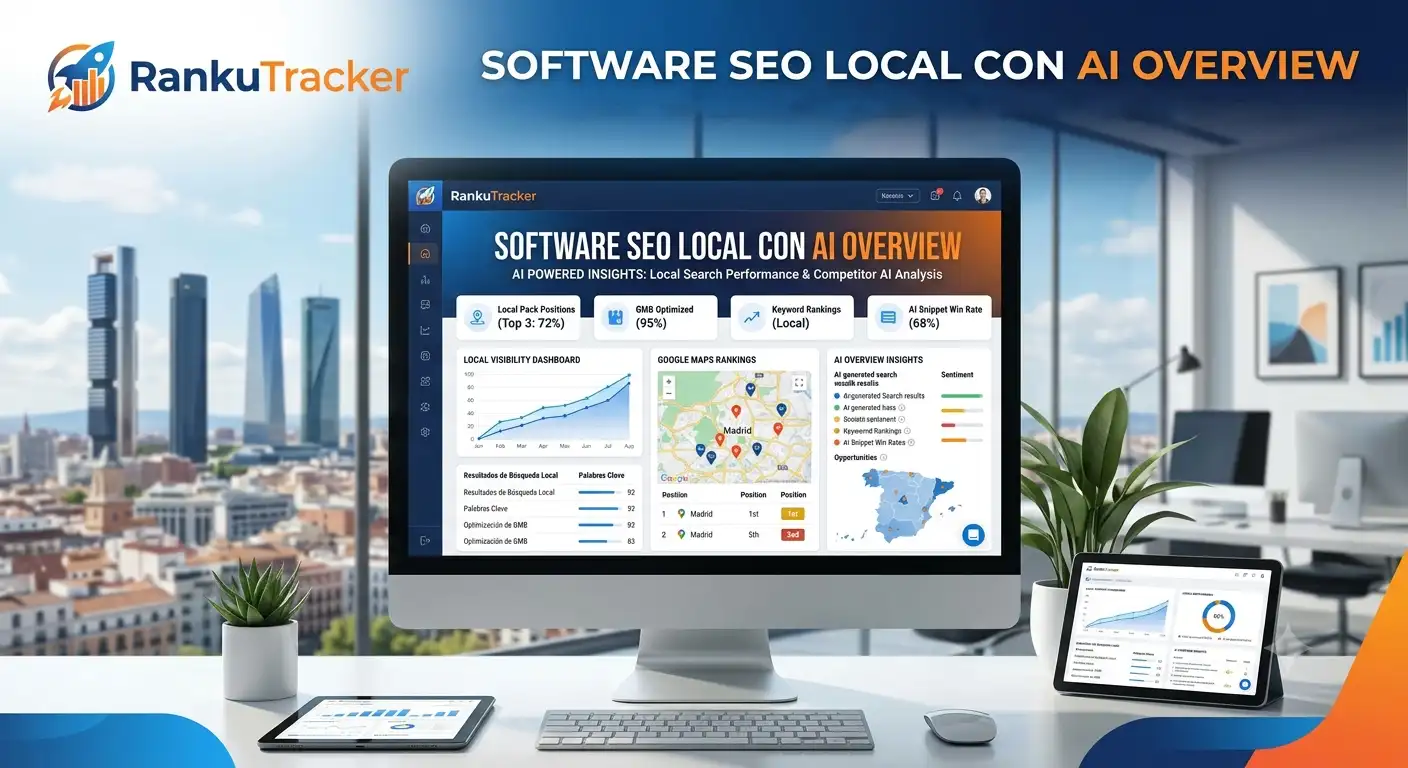
RankuTracker was built specifically around this list, at $50/month:
- RankTracker — real positions on Desktop, Mobile, and the Map Pack
- RankMap — hyperlocal heat mapping from real GPS coordinates
- NAP Audit — automated consistency monitoring across directories
- AI Review Management — monitoring and on-brand, sentiment-aware responses
- ScanSite — a technical audit scoped to what actually affects local rankings
- AI Overview Tracker — whether Google AI cites you in its responses, and at what position
- Copilot AI — prioritized, local-specific recommendations instead of generic SEO advice
The platform is designed for business owners, not SEO professionals: connect your Google Business Profile, enter your target keywords and locations, run a ScanSite audit, and let Copilot AI generate your initial action list.
The Bottom Line
If you run a local business and need to win on Google Maps, manage your reviews, and keep your NAP consistent, the tool that serves you best is the one built for that specific fight — not a generalist platform with local features bolted on.
Try RankuTracker free for 14 days at rankutracker.com